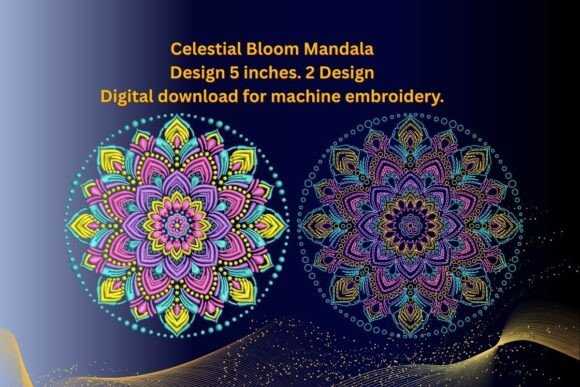
Celestial Bloom Mandala Embroidery
First Impressions: When Stars Meet Petals in Stitch
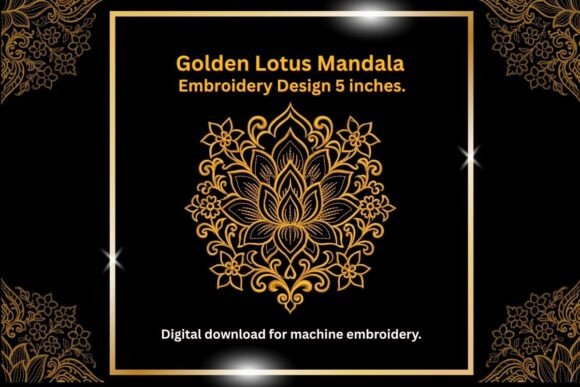
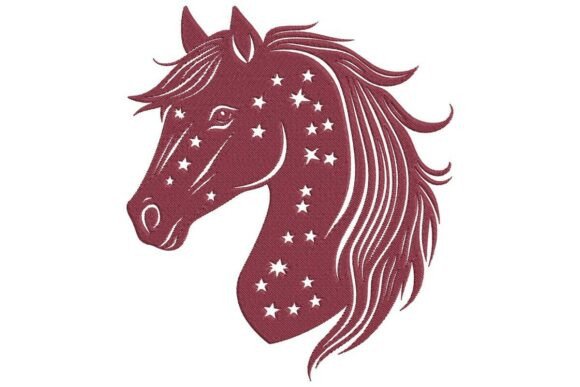
Unzipping the Celestial Bloom Mandala Embroidery files, I didn’t just see a mandala—I felt its intention. This isn’t a generic circular motif slapped with stars; it’s a deliberate fusion of cosmic scale and botanical softness. Two distinct patterns, each balancing symmetry with organic flow—think concentric rings that taper into delicate floral tendrils, punctuated by subtle star motifs that read as texture, not clutter. The overall mood is serene but grounded—not ethereal to the point of fragility, which matters when you’re stitching for real people who’ll wear, wash, and live with your work.
A Real Project Test: Custom Embroidered Tote Bags for a Local Boutique
Last week, I prepped five tote bags for a small-town apothecary’s spring launch—linen-cotton blend, medium weight, natural undyed base. I chose the smaller of the two Celestial Bloom Mandala Embroidery designs for the front pocket. Why? Because its outer ring stays clean at 3.8 inches, and the inner petal layer doesn’t collapse into a muddy fill stitch zone on textured fabric. On the tote, it landed exactly as hoped: elegant without shouting, detailed without demanding attention. Customers paused. They traced the curve with their fingers. That’s the quiet power of a well-balanced mandala—it invites closeness, not distance.
Where It Shines (and Where It Asks for Care)
The Celestial Bloom Mandala Embroidery excels in projects where presence matters more than punch: baby onesies (soft satin stitch petals hold up beautifully on Pima cotton), linen pillow covers (the open negative space breathes between stitches), and unstructured aprons (its radial symmetry flatters curved seams). It also translates cleanly into embroidered patches—no excessive underlay, no fragile thread bridges.
But be thoughtful: avoid it on ultra-thin voile or highly stretchy jersey without heavy cutaway stabilizer. The fine connecting lines between star points and petal tips can flutter or distort if tension isn’t dialed in. On dark fabrics, test contrast early—some thread palettes mute the celestial elements unless you choose metallics or high-luster rayon. And skip curved surfaces like baseball caps unless you’re using a cap frame and have confirmed the design’s outer diameter fits comfortably within your hoop’s usable area.
What It Does for Your Craft Business—Beyond Aesthetics
As an Etsy seller and small shop product developer, I judge embroidery files not just by beauty, but by how they shape perception. Celestial Bloom Mandala Embroidery elevates handmade credibility. Its cohesion tells customers you didn’t grab clip art—you curated meaning. That matters for personalized gifts (a baby’s first mandala on a muslin swaddle) and boutique branding (a subtle repeat on tea towel hems). It reads as intentional, not incidental.
I’ve watched buyers linger longer on listings featuring this design—especially when paired with clean, light-background mockups. It performs well in printable mockups too, because its balance of line and fill gives dimension even in grayscale. For commercial embroidery shops, it stitches consistently across machines when density is respected—no sudden jumps in stitch count that cause thread breaks or puckering.
Practical Designer Notes You’ll Actually Use
- Always test on scrap fabric first—especially with your exact stabilizer combo. Linen behaves differently than quilting cotton, and that difference shows in petal definition.
- Check thread color contrast before finalizing. A pale gold thread on cream linen reads warm and celestial; the same thread on oatmeal canvas can disappear.
- Review stitch density. If your machine struggles with dense fill areas, consider simplifying one inner ring manually—or embrace the slight texture it creates as part of the charm.
- Confirm hoop size compatibility. Neither design overextends beyond a 5x7 hoop, but the larger version fills it edge-to-edge—leave breathing room if your machine’s throat space is tight.
- Inspect small details at actual stitch size. Those tiny star accents? They’re legible at 3.5 inches—but vanish below 2.75 inches. Don’t shrink blindly.
- Test black-and-white mockups to gauge value contrast. If the design flattens visually without color, adjust placement or background fabric choice.
- Use proper stabilizer: medium tear-away for stable wovens, cutaway for knits or lightweight linens. Skip basic iron-on for this level of detail.
- Verify licensing before selling finished items or bundling the digital embroidery file. If resale rights aren’t explicitly stated, assume personal use only.
Not Just Another Mandala—A Design That Supports Your Intent
Mandalas are everywhere. What makes Celestial Bloom Mandala Embroidery different is its restraint. No overcrowded layers. No forced complexity. It leaves room—for fabric texture, for thread sheen, for the hand of the maker. That’s why it works equally well on a minimalist sweatshirt for a yoga studio and a vintage-style baby blanket for a wedding gift registry.
It’s also unusually versatile across product types: as a standalone focal point on a kitchen towel, as a repeating border on an apron hem, or scaled down as a delicate accent on a child’s backpack strap. I’ve used it both as a machine embroidery design and adapted one version into a simple applique design—its clean outlines make that transition seamless.
If you’re curating embroidery project assets for your craft business—or selecting a signature motif for your brand—Celestial Bloom Mandala Embroidery earns its place not because it’s trendy, but because it’s *reliable*. It delivers clarity without coldness, detail without delicacy, and harmony without cliché. That’s rare. And that’s why it stays in my active folder, not my archive.